
Every question opens a new path
Denkweg is a place to understand hard things. Start from a question, a topic, or an article, then ask about the exact part that stops you. Each answer opens a new path you can follow, branch again and always walk back from — with graphs, maps and diagrams where a picture says it better.
Free while Denkweg is in beta. An email address is all it takes.
Already have a path? Sign in01 · The idea
Your path through a topic, not a chat log
Hard ideas rarely fail all at once. It is usually one paragraph, one step in a derivation, one term that was never quite explained. In an ordinary chat you paste the fragment, spend three messages explaining where you came from, and lose the thread anyway.
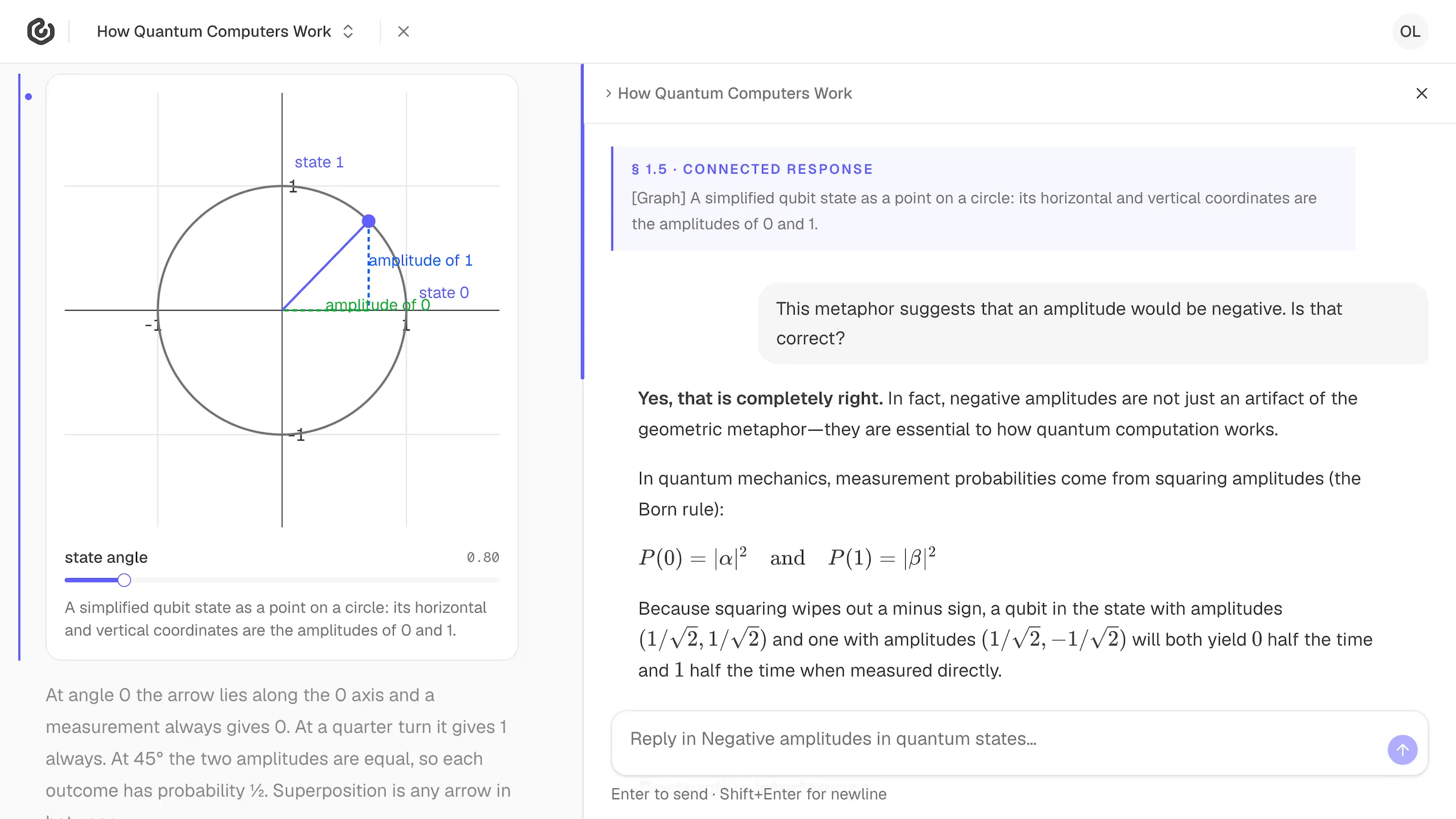
Your document, and every thread it opens
Your source stays in view while you ask about it. Every question, and everything that grows from the answer, stays attached to the passage it came from — nothing overwritten, nothing lost.
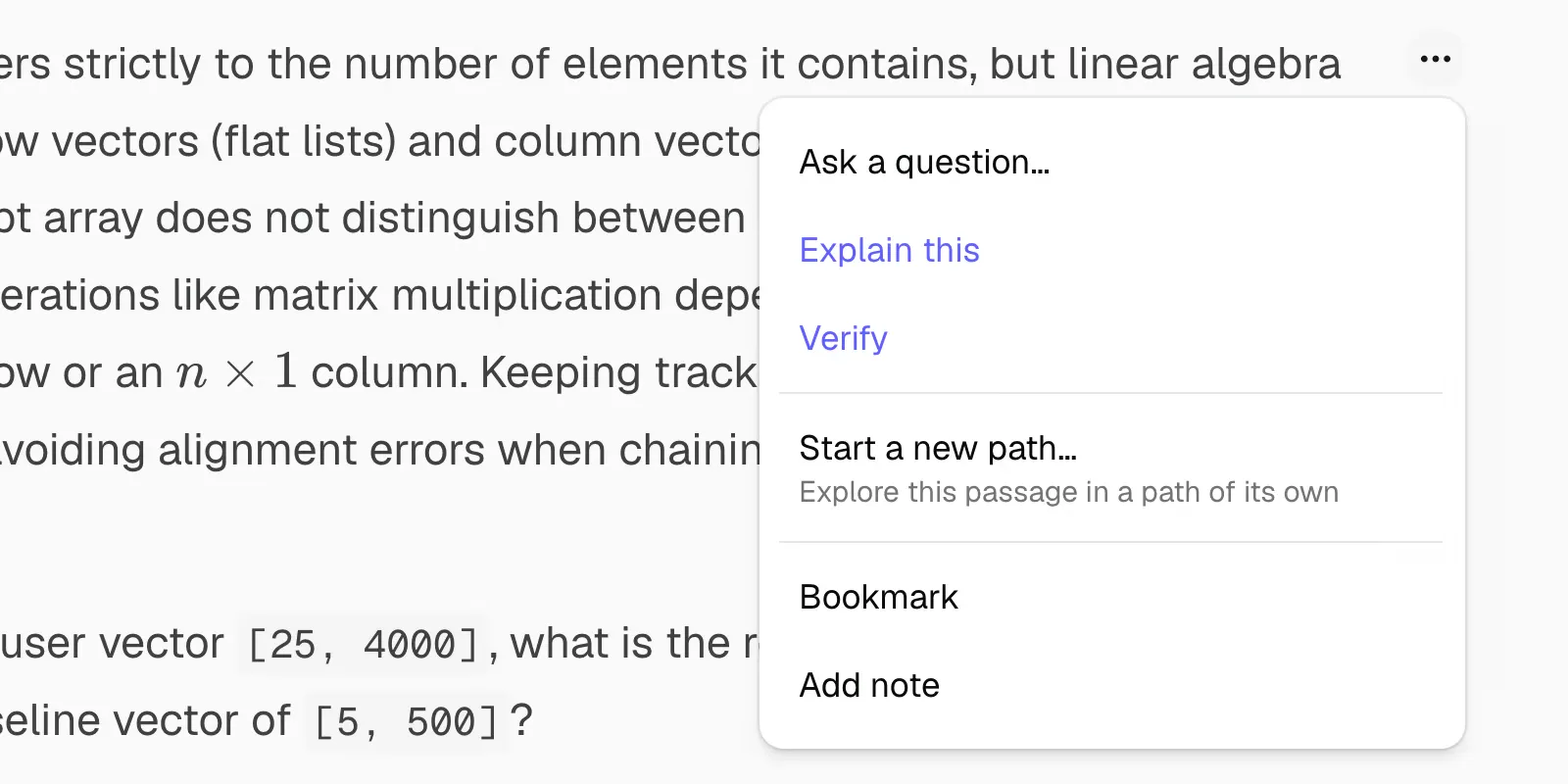
Point at the part that stopped you
Pick the paragraph that stopped you and ask about it directly, or ask Denkweg to explain, draw or verify it. Select a sentence to highlight it, add a note, or check it. The question opens already knowing the passage, the source, and the path you took to get there.
02 · How it works
Start wherever you are
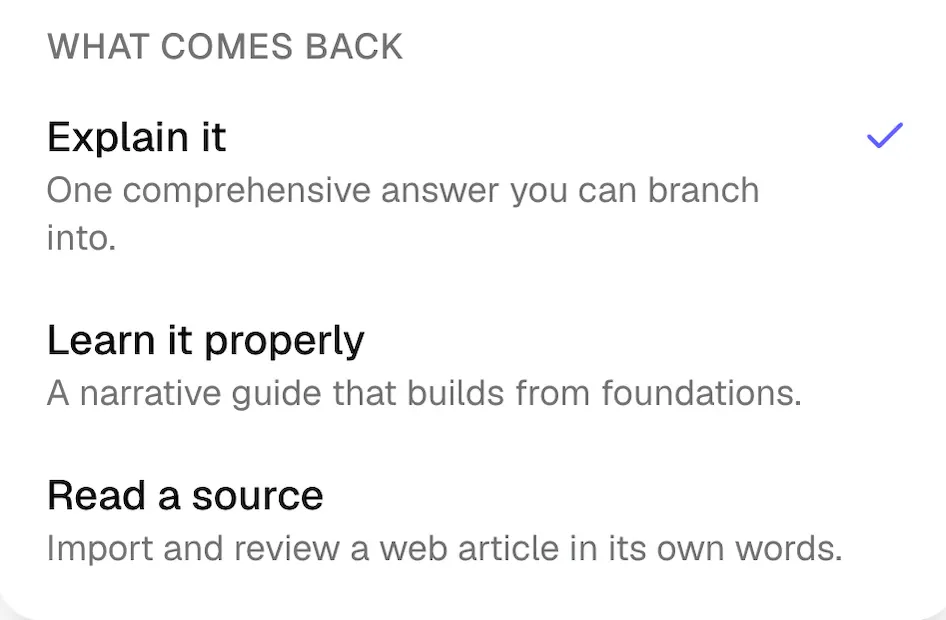
Get a quick explanation, a whole subject laid out, or the source itself — and go one step finer whenever a concept doesn't hold yet.
AExplain it
Why does ice float when most solids sink?
A complete written answer to the question you asked, with a figure where one helps. Every paragraph is a place to ask the next question.
BLearn it properly
I want to understand how vaccines train the immune system.
A map of the subject: chapters that each lay a foundation for the next, and a section for every idea worth going deeper on. You branch to go deeper, at your own pace rather than on a schedule.
CRead a source
A link to an article, a paper or a Wikipedia page
The article arrives in the author's own words, unsummarised and cleaned of clutter, ready to be questioned passage by passage.
Denkweg writes in the language you ask in.
03 · Visuals
When a picture explains more than a paragraph
Denkweg adds a figure when the point is a shape, a sequence, a place or a span of time that you would otherwise have to piece together from several sentences. The explanation always stands on its own; the figure makes it easier, never longer. Some figures in a learning plan ask you something first — what you expect to happen before you see it — and every figure is a passage you can ask about in turn.
The tangent to f(x) = x³/3 − x, and its slope read off f′. Graphs you can move
Drag a slider and watch the curve answer.
- Member towns
- Kontors abroad
- Dates approximate; borders shown are modern.
Towns and kontors of the Hanseatic League, 1150–1400. Maps that change with time
Move the year and watch a network spread.
- 6 steps
Step through the process with Next.
Light excites chlorophyll in photosystem II, which passes an energised electron on.
To replace that electron, photosystem II splits water, and oxygen is released.
The electron runs down the transport chain, which pumps protons into the thylakoid.
Light energises the electron again in photosystem I.
Photosystem I hands it on to make NADPH.
Protons flow back out through ATP synthase, which makes ATP.
The light reactions of photosynthesis. Processes, one stage at a time
Step through and see which part acts, and what it does.
- 128 June Assassination in Sarajevo
- 25 July Germany's “blank cheque”
- 323 July Ultimatum to Serbia
- 425 July Serbia replies
- 528 July Austria-Hungary declares war on Serbia
- 630 July Russia mobilises
- 71 August Germany declares war on Russia
- 83 August Germany declares war on France
- 94 August Britain declares war on Germany
- Central Powers
- Serbia and the Entente
The July Crisis, from Sarajevo to war in five weeks. Timelines on a true scale
Events and periods in their real proportions.
The area under a bell curve, up to a moving bound. Figures that play
Press play and watch a quantity build up.
Where the oxygen comes from
Photosynthesis is often summed up in one balanced equation:
It hides where the oxygen comes from. Photosystem II splits water: every two molecules of give one , four protons and four electrons.
The protons drive ATP synthase; the electrons end up reducing to .
A passage on photosynthesis, with its reactions typeset. Chemistry, written properly
Formulas and reaction equations, in the text where they belong.
04 · Verify
Check whether it's true
A model-written explanation carries no more authority than its training data, and an article no more than its author. Ask Denkweg to verify a passage and it picks out the claims that can be checked, searches the web for each one, and answers with a verdict and the sources it actually found. Where it can't back a verdict, it says so.
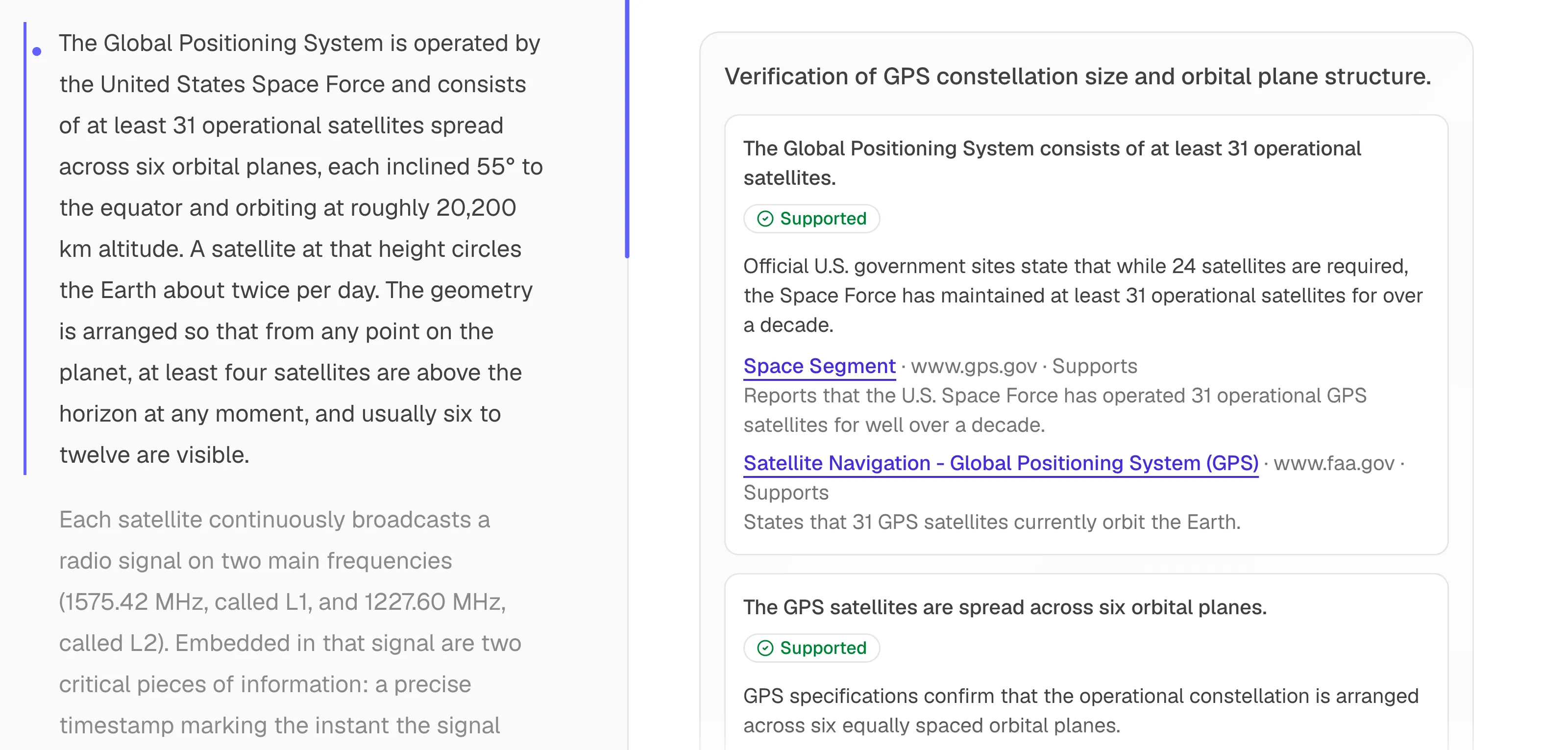
- aEach checkable claim, picked out of the passage.
- bA verdict for each one, with the sources it actually found.
- cWhere nothing backs a verdict, it says so instead of guessing.
05 · Your path
A path keeps what a chat forgets
Every branch remembers where it grew from, and every tangent stays. Come back to a question from last week and the whole path is still there.
Mark it
Bookmark a section, highlight a passage in colour the way you would with a pen, and add a note in your own words — or let Denkweg suggest one from the passage's key point for you to edit. Your marks are private.
Share it
Send someone a read-only link to a path Denkweg wrote for you, with the branches you choose to include. They can read it without an account, and start a path of their own from it.
Take it further
When a passage deserves a path of its own, start one from it. The new path opens with the passage quoted and attributed, ready for your question. Pin the paths you keep coming back to.
06 · Examples
Walk a path someone else took
These are real paths, shared read-only. Open one and see where the questions went. No account needed.
07 · A free beta
Open to curious minds
Denkweg is being built slowly, mostly for my own learning, and it is early enough to still be rough in places. If something gets in your way, I would like to hear about it.
Free while Denkweg is in beta. An email address is all it takes.
Already have a path? Sign in